Drug discovery has spent decades getting better at finding associations. We can identify genes that are overexpressed in disease, proteins that sit inside altered pathways, variants associated with risk, and network nodes connected to hundreds of relevant publications. The result is often a target score with impressive decimal precision.
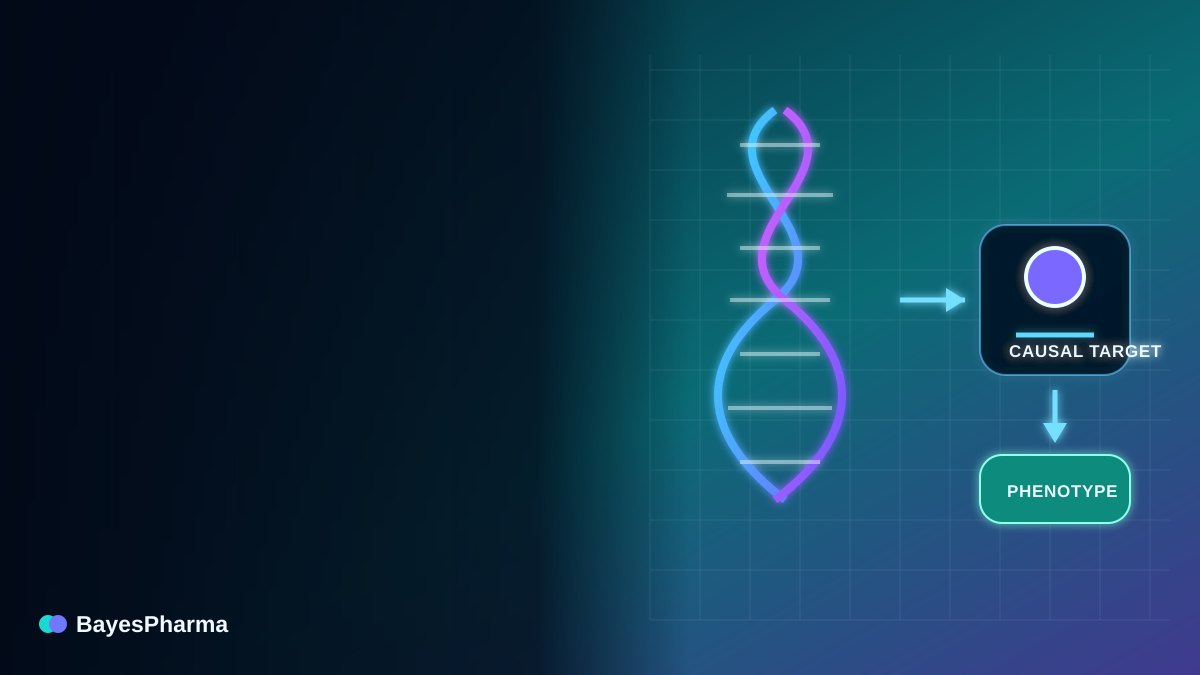
But an association answers a weaker question than a drug program needs. It says, “this target travels with the disease.” A medicine needs a causal claim: “changing this target, in the right direction, magnitude, tissue, and disease stage, will change the clinical outcome without causing unacceptable harm.”
Why correlation creates expensive mirages
Disease biology is full of passengers, compensatory responses, and downstream markers. A protein may rise because the body is trying to protect itself. Blocking it could worsen disease. A pathway may be highly active in late-stage tissue but irrelevant to disease initiation. A gene may correlate with poor prognosis because it marks a cell population rather than drives its behavior.
Even a clean perturbation can mislead. A complete gene knockout from the beginning of cell development is not the same intervention as partial, reversible inhibition in an adult patient. A high-concentration tool compound may produce a convincing phenotype through off-target activity. A cancer cell line may be dependent on a target only because years of culture selected an artificial state.
Target validation therefore has to move from accumulating supportive facts to testing a causal model.
Human genetics is powerful -- but not magical
Human genetics is one of the strongest forms of target evidence because nature has already performed a vast perturbation experiment across human populations. Variants that alter a protein’s function or expression can reveal whether lifelong modulation of that biology changes disease risk. Historical analyses have found that drug mechanisms supported by human genetic evidence are enriched among successful programs.
But genetics is not a permission slip. A variant may affect several genes or pathways. The causal gene can be difficult to identify. Lifelong modest modulation may not predict the effect of acute pharmacological inhibition. The relevant direction matters: a loss-of-function variant may protect against disease, while a proposed drug accidentally activates the same pathway. Tissue specificity and developmental timing can completely change the interpretation.
The correct use of genetics is not “gene associated, therefore target validated.” It is to sharpen a causal hypothesis: which molecular function, altered in which direction, in which tissue, during which phase of disease, is expected to change which outcome?
The perturbation ladder
A robust target argument should survive progressively harder perturbations:
- Genetic perturbation: CRISPR knockout, knockdown, activation, base editing, or allele-specific models.
- Pharmacological perturbation: selective small molecules, antibodies, degraders, or other modality-relevant interventions.
- Dose and time: partial versus complete modulation, acute versus chronic treatment, and reversibility.
- Orthogonal readouts: molecular engagement, pathway activity, cellular phenotype, tissue phenotype, and organism-level outcome.
- Rescue: restoring the target or downstream mechanism should reverse the phenotype if the causal story is correct.
Agreement across these layers is far more informative than repeatedly observing the same association in different datasets. Disagreement is equally valuable. If genetic knockout produces a phenotype but a selective inhibitor does not, the gap may reveal scaffolding functions, compensatory biology, inadequate target engagement, or an incorrect chemical probe.
A target is not validated when the evidence is abundant. It is validated when competing causal explanations become difficult to sustain.
Context is part of the target
The phrase “target X causes disease Y” is usually too crude. The real statement often looks more like this: inhibiting a particular function of target X by approximately 60% in a defined cell state, during an inflammatory window, in patients with a specific biomarker, is expected to improve outcome Y.
That context includes:
- Cell type and tissue compartment
- Disease subtype and stage
- Genotype and pathway state
- Direction and degree of modulation
- Timing and duration
- Relevant combination therapies
- Potential on-target liabilities in healthy tissues
Single-cell atlases, spatial biology, organoids, patient-derived models, and large perturbation datasets are valuable not because they add more rows to a database, but because they help define this context precisely.
From a target score to a causal dossier
A modern target-validation system should not collapse everything into one opaque number. It should expose the structure of the argument:
- What is the proposed causal chain from target modulation to clinical benefit?
- Which links are directly observed, inferred, or assumed?
- What evidence supports the direction and magnitude of intervention?
- Which models reproduce the relevant human context?
- What evidence contradicts the hypothesis?
- Which experiment would most efficiently discriminate between the leading explanations?
This is closer to a causal dossier than a ranking table. AI can help retrieve evidence, build mechanistic graphs, predict missing links, and simulate perturbations. It should not hide uncertainty behind a score. The value comes from making the causal assumptions explicit enough to challenge.
Kill the target before the target kills the program
The most expensive target failure is not a low-ranked idea that dies in a planning meeting. It is a biologically plausible target that survives years of chemistry, toxicology, and early clinical development before the mechanism proves irrelevant in patients.
Better causal validation will not eliminate failure. Biology is too adaptive and patients are too heterogeneous for that. But it can change the timing of failure -- moving it earlier, when the cost is an experiment rather than a Phase 2 program. That is one of the highest-value compressions available in drug discovery.