Ask someone to name the technology behind the current AI-in-biology boom and they'll say transformers, diffusion models, protein language models -- the generative, headline-grabbing layer. Almost nobody names the layer underneath it that decides which candidate is worth testing next, whether a trial has seen enough evidence to stop early, or how confident a physician should be in a specific patient's dose. That layer is Bayesian statistics, and it has quietly become as load-bearing to this revolution as the generative models everyone is talking about.
Bayesian optimization inside the generative loop
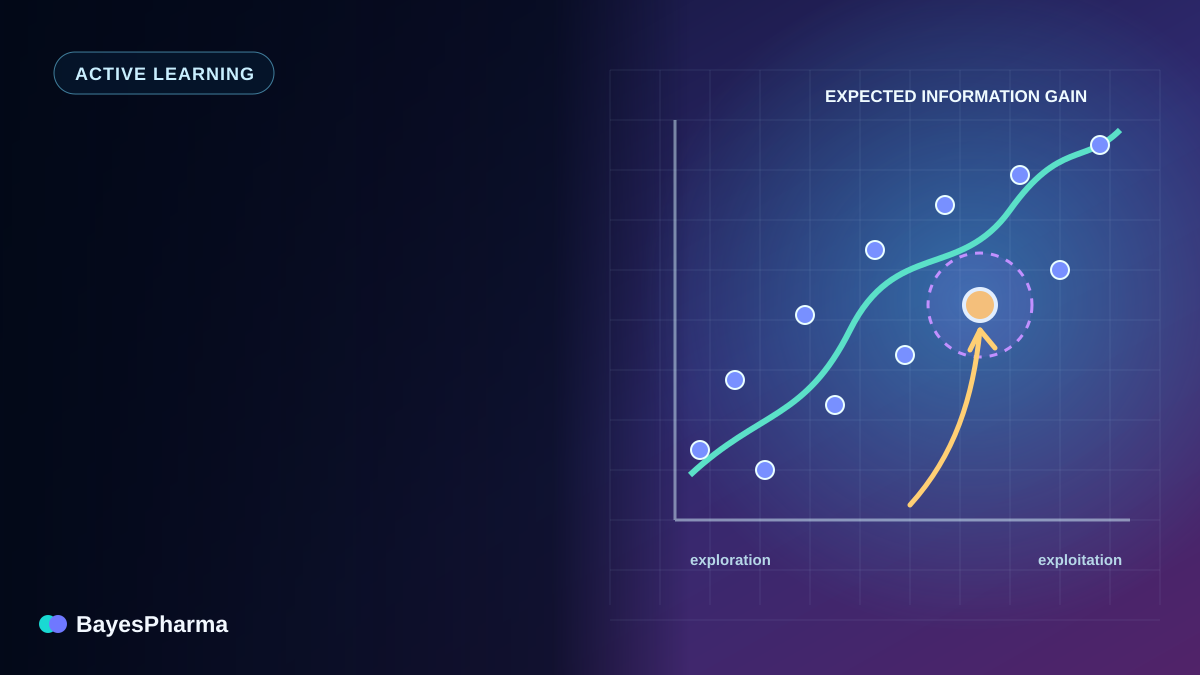
Generative chemistry gets described as a single leap -- ask a model for a molecule, get a molecule. In practice, the useful version of this is an iterative loop: propose candidates, synthesize and test a small batch, feed the results back, propose again. Deciding which candidates to test next in that loop, out of thousands of plausible options, is explicitly framed as a Bayesian experimental-design problem in most serious discovery pipelines -- the goal isn't just "pick the highest predicted potency," it's "pick the experiment that maximizes information gain given everything already known and how uncertain the model still is." That is Bayesian active learning, and it's the difference between a discovery program that converges in a handful of design-synthesize-test cycles and one that wastes months testing redundant candidates.
Population PK/PD: hierarchical Bayesian inference wearing a different name
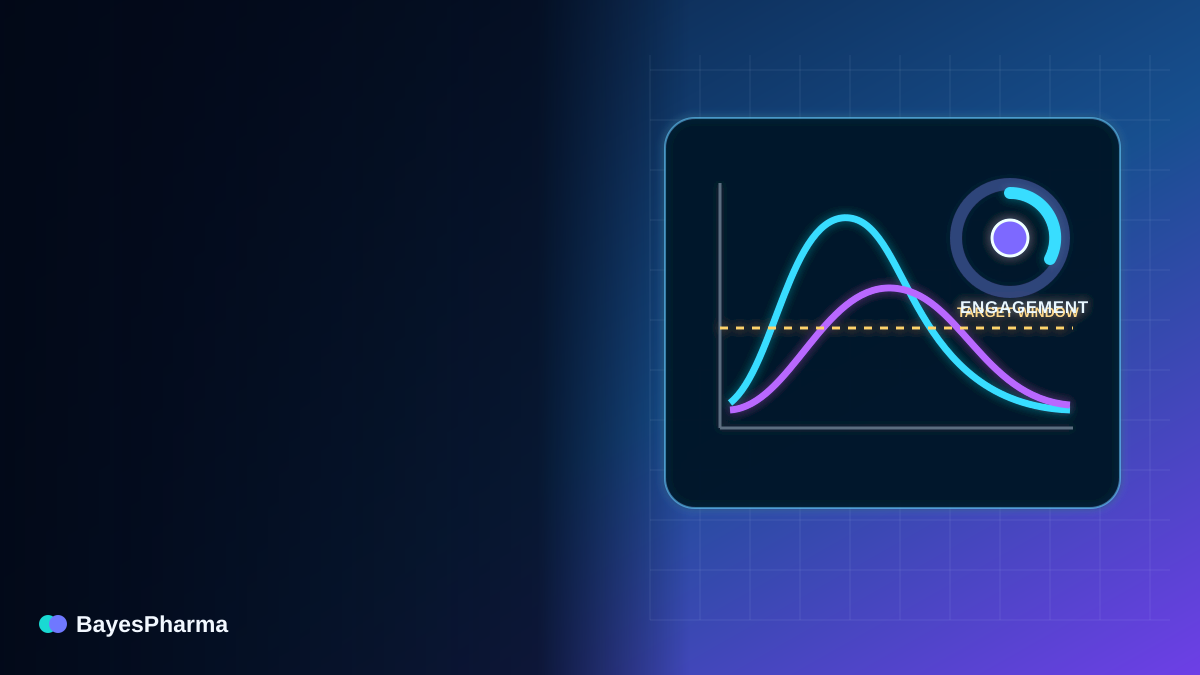
Population pharmacokinetic modeling -- estimating how a drug behaves across a population of patients rather than one person at a time -- is structurally a Bayesian hierarchical model, whether or not the software fitting it is labeled that way. A population PK model separates a "typical value" for clearance or volume of distribution (the population prior), individual deviations from that typical value (interindividual variability), and measurement noise (residual error). That three-way decomposition -- pool information across patients while still allowing each one to differ -- is exactly what a Bayesian hierarchical model does, and it's the mathematical backbone behind every dose-finding study and every population PK model built for a new drug's label.
Adaptive clinical trials: sequential Bayesian decision-making, in public
This is where Bayesian methods most directly answer the question raised in the previous piece in this series: how do you make clinical development itself faster without weakening the evidence? The answer the field has converged on is adaptive trial design -- interim analyses built into the trial from the start, with pre-specified rules for stopping early if a treatment is clearly working (efficacy), clearly not working (futility), or clearly unsafe. Response-adaptive randomization shifts more patients toward the arm that's performing better as evidence accumulates. Bayesian assurance calculations -- essentially, "what's the probability this trial succeeds given everything we currently believe about the drug" -- inform go/no-go decisions before a single patient is dosed. None of this cuts corners on statistical rigor; if anything it requires more rigor up front, because the stopping rules and priors have to be specified and defended before the data arrives. What it does is stop a trial as soon as the evidence genuinely supports a decision, instead of running every trial to a fixed calendar date regardless of what the accumulating data already shows.
An adaptive trial that stops six months early because the evidence is already conclusive isn't cutting a corner. It's exactly what rigorous evidence-based decision-making is supposed to look like.
Individualized dosing: Bayesian updating in real time
The same logic scales down to a single patient. Maximum a posteriori (MAP) Bayesian estimation takes a population PK model's priors -- what's typical for patients like this one -- and updates them with a specific patient's own observed drug concentrations to produce an individualized dose recommendation. It's the same underlying mathematics as the population model and the same underlying mathematics as an adaptive trial's interim analysis: start with a defensible prior, update it with real evidence as it arrives, and be explicit about the remaining uncertainty rather than pretending a single point estimate is the whole truth. This is the mechanism running underneath population PK tooling and MAP Bayes dosing calculators built for exactly this purpose -- not a separate innovation from the AI drug discovery story, but its direct statistical continuation into the clinic.
Why this matters more, not less, in an AI-accelerated pipeline
Every stage upstream in this series -- generative chemistry proposing better candidates faster, structure prediction replacing months of crystallography, foundation models surfacing targets that would have taken years to find by hand -- increases the volume and speed of hypotheses entering the pipeline. That makes the downstream question of which hypotheses deserve trust, and how much, more important, not less. A faster discovery engine that feeds an unchanged, non-adaptive, uncertainty-blind development process doesn't actually produce faster approvals -- it just produces a longer backlog waiting at the clinical bottleneck. The Bayesian layer is what lets the acceleration upstream actually propagate downstream: better priors from richer preclinical data, adaptive trials that stop as soon as the evidence is in, and individualized dosing that reflects what's actually known about each patient rather than a population average. It's the connective tissue between "we can generate candidates faster" and "we can generate approved medicines faster" -- and it deserves a lot more of the credit it currently isn't getting.